The State of Taiwan’s Higher-Education IT Departments in 2014: What Did the Survey Report Reveal?
As cyberattacks and the big data wave arrive together, can campus IT departments keep up in staffing and budget?
Dr. Michael Cheng, ISAC board member and Chairman of WisdomGarden, presents the "2014 Survey Report on the Current State of Information Departments and Key IT Issues in Taiwan's Higher Education Institutions"
In 2014, the Ministry of Education launched the "Campus Administration E-Transformation Exchange Program," commissioning ISAC (Association for Information Service of Higher Education) to carry it out. The program scheduled five seminars over the year to steadily raise the level of administrative digitalization at schools of all levels and narrow the digital gap between institutions.
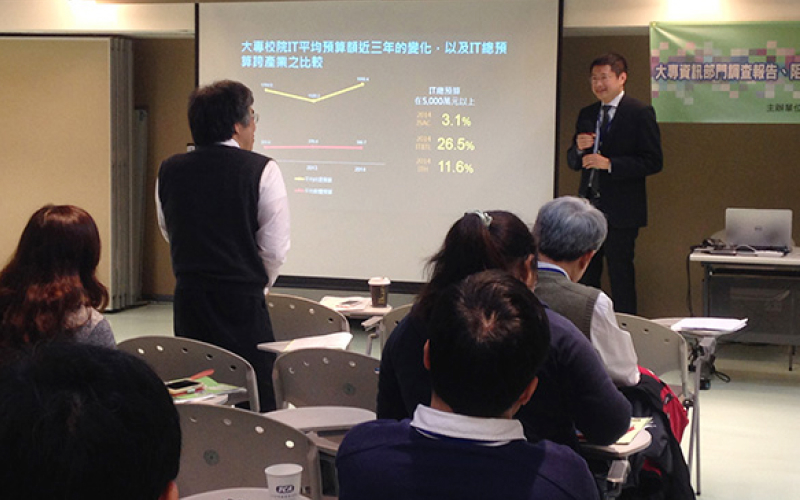
In January 2015, the program reached its fifth and final session, held at the B1 Club Center of the Taipei Computer Association. Topics ranged from the survey report on higher-education information departments, denial-of-service attacks, and the operation of large-scale education networks, to R+Hadoop data analytics technology and leadership experience sharing—covering nearly the entire list of the most pressing issues facing campus information units at the time.
The most anticipated opening session, "2014 Survey Report on the Current State of Information Departments and Key IT Issues in Taiwan's Higher Education Institutions," was delivered by Michael Cheng, ISAC board member and Chairman of WisdomGarden, and co-moderated by Yen Sy-jun, Director of the Computer and Information Networking Center at National Taiwan University, and Chen Kung, Director of the Computer Center at National Chengchi University.
The survey report directly addressed questions that campus information departments have long faced but that are rarely examined systematically: What is the actual state of information departments across Taiwan's higher-education institutions? Is staffing sufficient? Is the budget size reasonable? Can existing organizational structures cope with increasingly complex cybersecurity threats and rapidly evolving technology needs? Cheng's report provided a national-level set of comparative data on issues that had long remained confined to internal discussions within individual schools.
The value of this session lay not only in the data itself but in giving IT leaders nationwide their first chance to see, in a single report, their own school's situation and where it stood relative to others.
The rest of the agenda—from how to respond to denial-of-service attacks and hands-on experience operating large-scale education networks, to R+Hadoop data analytics technology, and an afternoon in-depth dialogue among four IT leaders on staffing and budget issues—kept coming back to the same core theme: technology keeps evolving, but are organizations and resources ready to absorb these changes?
Is your school's information department currently staffed and funded well enough to meet increasingly complex cybersecurity and technology challenges? We invite you to share your observations in the comments.
Want to learn more? Let’s talk.
We welcome university information units, computing centers, and education technology partners to connect with WisdomGarden and explore together how information departments can allocate their organization and budget more rationally.