Security, Cloud, and Smart Campus: A National Consensus Gathering for Higher-Education IT Leaders
When four major trends arrive at once, where should a school's IT governance go?
Dr. Michael Cheng, board member of ISAC (Association for Information Service of Higher Education), presents the "Survey Report on the Organization and Budget Rationality of Information Units in Colleges and Universities"
The widespread adoption of mobile devices, the constant iteration of new cloud technologies, digital learning reshaping the classroom, and the rollout of smart campus projects—these four major trends are hitting Taiwan's colleges and universities all at once. Behind every one of these initiatives lies the same practical question: do a school's information units have enough staff and budget to keep up?
This question was addressed head-on at CCDS2015, the "2015 National Seminar for Higher-Education IT Administrators," held in December 2015.
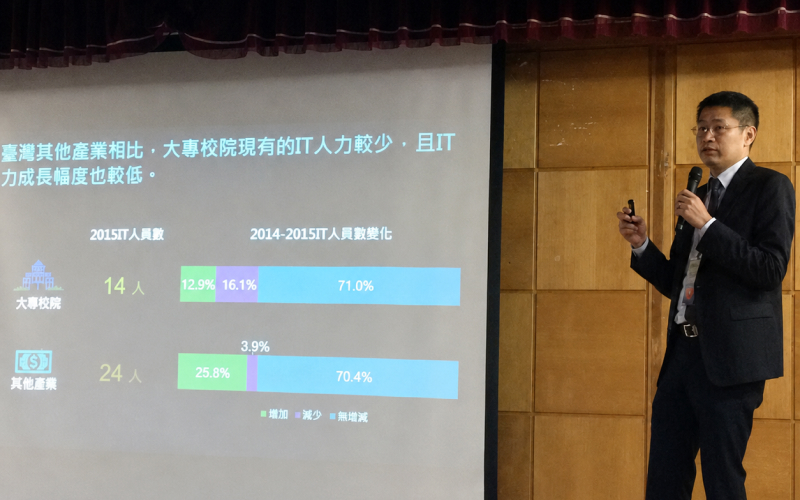
Held at Jinwen University of Science and Technology under the theme "Cybersecurity, Connectivity, and the Smart Campus," the seminar brought together computing center directors, chief information officers, and division heads from colleges and universities nationwide. Among the many topics, the "Survey Report on the Organization and Budget Rationality of Information Units in Colleges and Universities," presented by Michael Cheng, board member of ISAC (Association for Information Service of Higher Education), was the session that most directly spoke to the concerns of the IT leaders in the room.
The report was not an abstract trend forecast but a solid set of comparative data: where each school's information unit falls in terms of organizational structure, staffing, and budget size, and whether these are reasonable relative to peer institutions. For IT leaders who spend years in budget meetings needing data to persuade their administrations to invest more resources, this kind of survey report offers a highly persuasive point of reference.
Cybersecurity requires people, building a smart campus requires people, and advancing digital learning requires even more people. But where those people come from and how the budget should be allocated are often the hardest things for an information unit to communicate to others. Cheng's report brought this long-overlooked issue onto a stage where IT leaders from across the country could focus on it together.
Technology trends are updated year after year, but if organization and budget never keep pace, even the best technology will struggle to truly take root.
Is your school's budget allocation for digital learning sufficient to support current development and rollout needs? We invite you to share your observations in the comments.
Want to learn more? Let’s talk.
We welcome university information units, computing centers, and education technology partners to connect with WisdomGarden and explore together how budgets for digital learning can be allocated more rationally.