How Cross-Disciplinary AI Innovation Is Reshaping Chinese-Language Teaching: 3 Key Insights from the International Summit on Chinese Language Teaching in Taiwan
Language learning is one of the most complex cognitive activities humans undertake—and AI is redefining what's possible in ways never seen before.
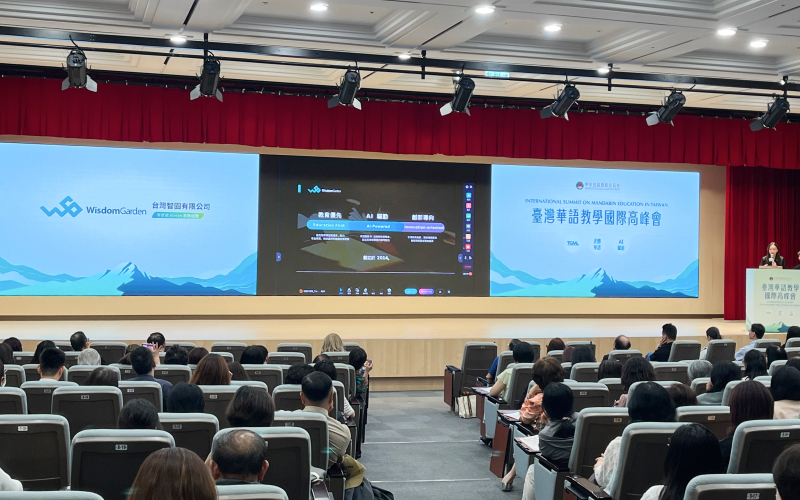
Li Yen-yi, Account Manager at WisdomGarden, presents TronClass AI applications
The International Summit on Chinese Language Teaching in Taiwan is a major annual gathering of Chinese-language educators from around the world. At this year's event, WisdomGarden shared three core insights into how cross-disciplinary AI innovation plays out in real classrooms—sparking wide-ranging discussion.
Insight 1: The most valuable role for AI in language teaching isn't replacing the teacher's own modeling of language, but closing the structural gap created by a severe shortage of one-on-one instruction time.
The fundamental limitation of the traditional Chinese-language classroom is that a single teacher faces twenty to thirty students, leaving each with very little individual feedback time. AI-assisted, real-time speech and grammar assessment gives every student precise feedback during practice, freeing teachers from repetitive evaluation work so they can focus on higher-level instructional guidance.
Insight 2: Cross-disciplinary integration is a key strategy for boosting motivation in Chinese-language learning.
Connecting language learning with content from culture, history, and the arts not only strengthens learners' intrinsic motivation but also builds a deeper cultural understanding of the language. AI makes this kind of cross-disciplinary course design scalable—turning an individual teacher's creativity into a teaching model that can be systematically replicated.
Insight 3: Learning data is the compass for instructional improvement.
By continuously analyzing learning behavior, teachers can clearly see which instructional designs are most effective and which learners are at high risk, grounding every teaching decision in data rather than relying on experience and intuition alone.
Together, these three insights point to a single core conclusion: AI's best role in Chinese-language teaching is to augment teachers' capabilities, not to replace their judgment. The ceiling of any technology is always the imagination of the people who use it.
In your own experience with language teaching or learning design, which part of the process most urgently needs AI's help?
Want to learn more? Let’s talk.
For more on innovative AI applications in Chinese-language teaching, visit the WisdomGarden website or reach out to our education consultants.