A New Course Model: HyFlex (Hybrid-Flexible)
A new course model: Hybrid-Flexible (HyFlex).
Hybrid-Flexible Course Mode
As the pandemic evolves, the online instruction that was rolled out on an emergency basis may struggle to keep pace with shifting external conditions and the steady, ever-growing learning needs of students from all walks of life. Through five questions, this article offers an introductory look at a new course model gaining momentum around the world: the Hybrid-Flexible Course Model (HyFlex).
1. What is the Hybrid-Flexible Course Model?
The concept is neither entirely new nor especially old. EDUCAUSE first offered a foundational introduction to it back in 2010, when the internet was steadily maturing and large-scale open online course models (MOOCs) were still taking shape. Today, against a backdrop of high-speed networks, smart classrooms, online platforms, and course-recording and live-streaming applications, the pandemic that struck early this year has accelerated the transformation of course delivery, bringing the Hybrid-Flexible Course (or HyFlex Course) back into focus.
In March and April of this year, UNESCO and the Smart Learning Institute of Beijing Normal University (SLIBNU) released a series of explanations and guidelines on flexible learning. These publications summarized teaching methods and cases such as live streaming, online interaction, MOOC-based learning, video-driven flipped teaching, and group learning, and introduced online and flexible perspectives spanning design, methods, content tools, activities, and outcome assessment—all intended as practical references for teaching and learning during the pandemic. At that stage, the effort to keep learning going despite class suspensions was approached primarily from the standpoint of online and remote teaching.
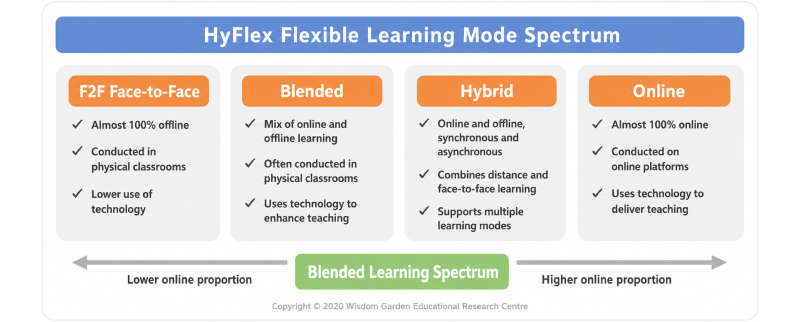
EDUCAUSE, San Francisco State University, the College of DuPage, and others have successively introduced concepts such as Hybrid Learning and the HyFlex Course to the international higher-education community. Put simply, a Hybrid-Flexible course is a teaching model that combines face-to-face (F2F) instruction with online learning (see Figure 1), in which students can access or take part in course content and activities in person, synchronously online, or asynchronously online. The HyFlex model emphasizes flexibility of learning choice, delivering a student-centered, multimodal learning experience while making course delivery more varied.
2. How is the HyFlex model implemented?
The HyFlex model asks instructors to rethink and redesign how students can effectively engage and interact with the instructor, the content, and their peers. So how is it put into practice? We can examine this simply from three angles.
1.Course resources: In the HyFlex model, all course resources need to be available online. However students choose to participate (in person, synchronously online, or asynchronously online), they must be able to access the learning content and tools the course provides. In addition, on-site and remote instructors and students alike should be able to share resources such as documents, animations, audio files, and videos with one another.
2.Course activities: Some instructors and students may be in a physical classroom while remote students join via live stream. The HyFlex model needs to offer online discussion forums and chat spaces so that all students can take part in the exchange, and when necessary, enable selected or all remote participants to turn on video and audio for real-time interaction. Live activities that the instructor launches during class—roll calls, polls, in-class quizzes, and the like—must also engage every student and be presented synchronously on a shared, visual display.
3.Course guidance: Some students will need support services for taking the course, such as instructions for logging in, guidance on using video tools, or an overview of platform features. The corresponding materials and step-by-step guides must be fully prepared and published in advance, and kept available at all times—for example, by uploading tutorial videos to a permanent online repository or providing interactive onboarding guides on the online platform.
3. Why do we need to understand the HyFlex model?
The day-to-day operation of teaching at colleges and universities can be disrupted by external, hard-to-predict factors such as climate change, natural disasters, and health crises. The pandemic in the first half of 2020 is a real-world case in point: it prevented instructors and students from returning to campus as usual, severely affected how courses were run, and forced many faculty members to hastily adopt unfamiliar platform tools and rapidly launch online teaching.
Reflecting on the online teaching that was hastily implemented over the past six months, many experts and scholars worldwide have pointed out that Emergency Remote Teaching is not the same as Effective Online Instruction. As campuses gradually reopen and face-to-face classroom teaching returns, schools and instructors will face many uncertainties around health and safety, budgets and funding, and travel and commuting.
Faced with the challenge of serving students in differing circumstances while teaching, learning, and research must continue to move forward, the HyFlex model offers a relatively flexible and varied path. Enabling students to choose for themselves, keep learning, and learn how to learn is the very essence of keeping learning going without interruption.
4. What are the challenges of implementation?
Implementing the HyFlex model tends to involve the following six common challenges.
1.Integrating technology with the curriculum: The technology chosen and used must match the needs of the course, run reliably, and ensure that users (administrators, instructors, students, and others) can access and use it whenever needed, with ongoing maintenance and updates.
2.Support for all students: Students may have very different hardware, software, and network conditions. It is essential to ensure that every student can reach the necessary URLs and download links, and can access the guidance and instructions they need at any time.
3.Instructor adaptability and capability: Most instructors may be more comfortable with in-person synchronous teaching (such as F2F), but synchronous online delivery (such as live streaming or broadcasting) and hybrid teaching (for example, teaching face-to-face in a physical classroom while simultaneously streaming out and interacting with remote students) require further learning and practice. Some instructors may also need to build more experience in designing content and activities for asynchronous teaching.
4.Ensuring course resources are accessible: Course resources first need to be digitized and uploaded to an online space that every student can reach and use. This reduces the constraints of physical teaching materials while increasing the reach and reusability of resources across users.
5.Course design and enrollment rules: Traditional courses take place mainly in physical classrooms, with class-size limits set by room capacity or instructor circumstances and established rules governing how and how many hours students register, select courses, and attend class. These need to be adjusted to fit the new model.
6.Bias against a new model: The effectiveness of the HyFlex model depends in large part on students' attitudes, motivation, and behavior toward self-directed learning. Moreover, if administrators and instructors themselves harbor too much distrust of this teaching model and cannot unite behind it, this will fundamentally affect how well HyFlex can be put into practice.
5. What does it mean for teaching and learning?
From a learning standpoint, the HyFlex model provides flexibility in both teaching and learning, aiming to lower the barriers for students to access and participate in courses. It lets as many students as possible obtain useful resources and engage in meaningful learning through their own chosen mode, thereby improving the learning experience and helping them meet their learning goals. Today, institutions such as the University of Michigan and San Francisco State University in the United States, Cambrian College in Canada, KU Leuven in Belgium, Zhejiang University in China, and Shanghai Open University are all exploring and implementing HyFlex Courses to varying degrees.
On the teaching side, the HyFlex model offers flexibility in course design, but it also poses challenges for course development and instructor capability. International assessment metrics for online course teaching already include corresponding dimensions and requirements. At a minimum, institutions can review their current courses and teaching across three dimensions—F2F, synchronous teaching, and asynchronous teaching—and plan and roll out systematic, topic-based professional training for instructors with different capabilities and profiles, strengthening the knowledge and skills required and building a new kind of teaching-talent team.
It is worth noting that, based on our institute's experience and observations, the HyFlex model is not necessarily suited to every course. Teaching that must take place in laboratories, clinical settings, or specific locations (such as cinemas, historic sites, or riverbanks), for instance, relies on synchronous, hands-on, in-person participation to deliver the best learning experience and outcomes.
[Copyright and Disclaimer] This article is copyrighted by the WisdomGarden Institute of Educational Research. To cite its content, please credit the source: WisdomGarden Institute of Educational Research.
References
Want to learn more? Let’s talk.
Get in touch with WisdomGarden to see how AI TalentTech can accelerate your talent development.